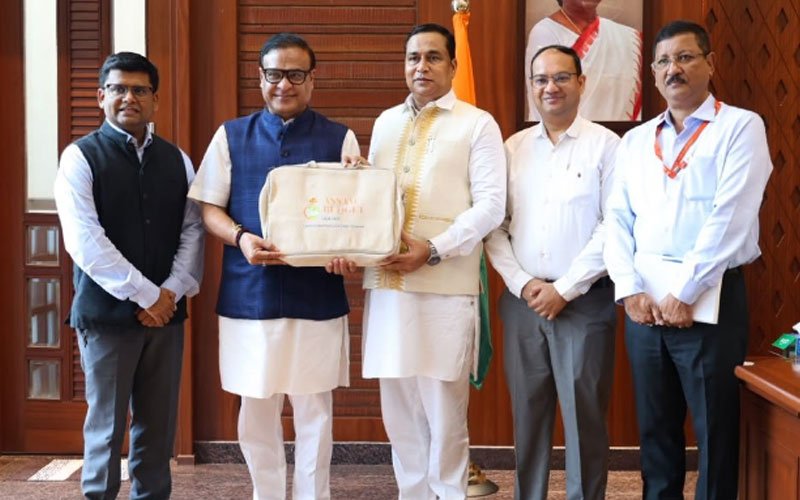
Guwahati: The Assam Government on Friday presented a ₹2,85,084 crore Budget for the 2026-27 financial year, outlining an expansive development agenda centred on infrastructure, power, healthcare, agriculture and social welfare, while maintaining the fiscal deficit at 3 per cent of the Gross State Domestic Product (GSDP).
Presenting his maiden Budget in the Assam Legislative Assembly, Finance Minister Jayanta Mallabaruah said the State enters the new financial year from a position of fiscal stability and outlined measures aimed at sustaining economic growth alongside expanding public investment. He began his address by invoking “Om Ganeshaya Namah” and paid tribute to Bharat Ratna Dr Bhupen Hazarika on his birth centenary, drawing inspiration from the legendary musician’s message of humanity. The Minister also cited Kautilya’s Arthashastra, emphasising that the welfare of citizens remains the guiding principle of governance.
The Budget estimates receipts of ₹1,51,843.23 crore under the Consolidated Fund against an expenditure of ₹1,56,714.88 crore for 2026-27, with the fiscal deficit pegged at 3 per cent of GSDP. Including the Public Account and Contingency Fund, total receipts are projected at ₹2,88,309.45 crore, while total expenditure is estimated at ₹2,85,084.45 crore. The State is expected to end the financial year with a closing deficit of ₹419.26 crore.
Highlighting the State’s financial position, Mallabaruah said Assam’s Budget size had expanded to ₹2,00,782 crore in 2025-26, while its own tax revenue increased to ₹39,294 crore and capital expenditure rose to ₹26,531 crore. He added that the debt-to-GSDP ratio remains at 24.81 per cent, comfortably below the Fiscal Responsibility and Budget Management (FRBM) ceiling of 32 per cent. The government has also set a target of increasing the share of its own revenue in total receipts from 36 per cent to 50 per cent by 2031.
Infrastructure emerged as one of the Budget’s major priorities. Under the proposed Asom Mala 4.0 programme, the government plans to construct 800 kilometres of roads over the next five years with an investment of ₹10,000 crore. The Budget also earmarks ₹2,100 crore for land acquisition related to the proposed Aerotropolis near Lokpriya Gopinath Bordoloi International Airport and allocates ₹500 crore over five years for the development of the Dibrugarh State Capital Region.
The government also announced an ambitious ₹77,353 crore investment pipeline for the power sector to transform Assam into a power-surplus state. The plan includes investments in a 3,200 MW thermal power plant, pumped storage projects, hydel projects, solar energy, battery storage systems and power transmission infrastructure.
To strengthen agriculture, the Budget proposes an irrigation expansion programme with investments of ₹3,000-4,000 crore over the next five years. An allocation of ₹200 crore has been made to prepare a comprehensive irrigation plan, while ₹100 crore has been earmarked to promote organic certification and agricultural exports.
On the welfare front, more than ₹6,000 crore has been allocated for flagship schemes, including Orunodoi, pensions, student assistance, farmer support and tea garden welfare. The government also announced that welfare payments suspended during the election period will resume from August.
Healthcare received a significant boost with proposals to create 33,240 new posts, establish four new medical colleges and set up a ₹550 crore Proton Therapy Centre at Gauhati Medical College and Hospital. The Budget also includes measures to strengthen healthcare infrastructure across the State.
The Budget proposes several tax relief measures, including raising the Agricultural Income Tax exemption limit for small tea growers from ₹2.5 lakh to ₹10 lakh, reducing VAT on piped natural gas from 14.5 per cent to 5 per cent, exempting stamp duty on loans of up to ₹10 lakh taken by women Self-Help Group members and extending a 3 per cent motor vehicle tax subvention for electric vehicle buyers.
To improve revenue mobilisation, the government has proposed introducing a GIS-based property valuation system, implementing an e-Khazana-based land revenue collection mechanism, expanding compulsory property registration and launching a one-time settlement scheme for pending tax and vehicle fitness dues.
The Finance Minister said technology-driven governance, improved tax compliance and prudent fiscal management would remain central to strengthening Assam’s revenue base while supporting long-term economic development and public welfare.