
US President posts map claiming American control as shipping activity shifts towards Oman route
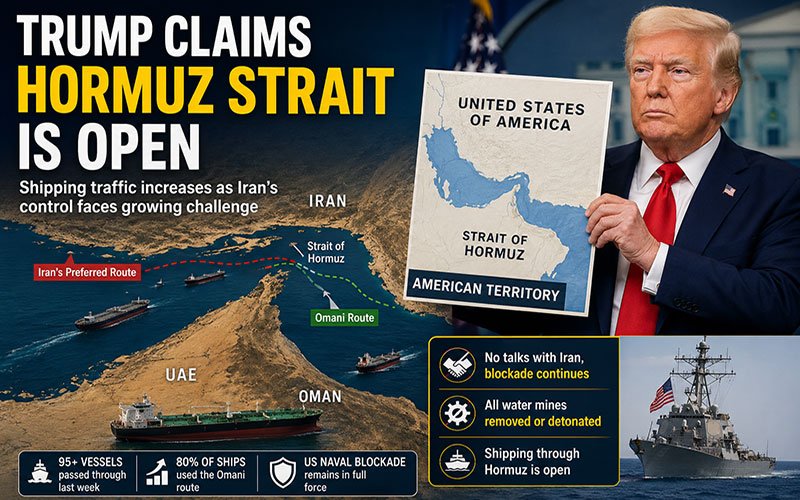
US President Donald Trump has made a fresh and dramatic claim regarding the Strait of Hormuz, declaring that the strategically vital waterway is now open for shipping and asserting that all underwater mines allegedly placed in the area have either been removed or destroyed.
In a post on his Truth Social platform, Trump also shared a map depicting the Strait of Hormuz as American territory, further escalating the political and military rhetoric surrounding one of the world’s most important energy corridors.
Trump said there were currently no negotiations underway between Washington and Tehran and maintained that the US naval blockade would continue.
“There are no talks or conversations going on, or scheduled, with the Islamic Republic of Iran. The Naval Blockade remains in full force and effect,” Trump wrote.
He further claimed that shipping operations had resumed in the region after the removal or destruction of mines.
“The Hormuz Strait is open and operating. All water mines have been removed or detonated.”
Iran’s Grip Over the Strait Under Pressure
The latest development comes amid signs that Iran may be facing increasing difficulty in maintaining control over maritime traffic through the Strait of Hormuz.
The narrow passage is one of the most strategically significant waterways in the world, with a substantial portion of global crude oil and liquefied natural gas traditionally passing through it.
According to maritime data cited by CNN, shipping activity through the strait has increased in recent weeks. Vessel-tracking information from MarineTraffic reportedly showed that at least 95 vessels crossed the waterway last week, following 118 vessels during the previous week.
A significant proportion of these ships reportedly used a route along the coast of Oman rather than the channel preferred by Iran. Data from global shipping intelligence firm Kpler indicated that around 80 per cent of vessels passing through the strait over the past two weeks chose the Omani route, a recognised international shipping channel that Tehran has strongly opposed.
Homayoun Falakshahi, head of crude oil analysis at Kpler, told CNN that the changing shipping pattern suggests Iran may be losing at least some of its influence over the strategically important passage.
Shipping Patterns Shift After Earlier Disruptions
The recent increase in traffic through the Omani channel represents a significant change from conditions seen only a month earlier, when maritime activity along the route was reportedly minimal.
The shift has also affected Iran’s ability to impose transit charges on ships using the waterway. Following the expiration of the Memorandum of Understanding between the United States and Iran, Tehran had reportedly sought to resume collecting tolls from vessels passing through the strait.
However, the growing use of alternative shipping routes has limited Iran’s ability to collect such charges.
Dan Pickering, founder and chief investment officer at Pickering Energy Partners, told CNN that many regional stakeholders have little interest in complying with Iran’s demand for transit fees, making the Omani route a more practical option for commercial shipping.
Tankers Resort to ‘Dark Shipping’
Meanwhile, major oil-producing countries in the Gulf, including Saudi Arabia, Kuwait and the United Arab Emirates, have reportedly adopted alternative methods to move crude out of the region.
According to Andy Lipow, president of Lipow Oil Associates, some countries have used Very Large Crude Oil Carriers, or VLCCs, to transport oil through the Strait of Hormuz before transferring the cargo to other vessels outside the high-risk zone in the Gulf of Oman.
Some of these tankers reportedly switched off their tracking transponders for extended periods in an apparent attempt to reduce the risk of being targeted. This practice, commonly referred to as “dark shipping,” makes it more difficult for commercial tracking platforms to accurately monitor vessel movements.
As a result, actual shipping volumes through and around the Strait of Hormuz may be higher than figures reported by conventional vessel-tracking systems.
CNN reported that US monitoring data has indicated significantly greater levels of oil movement than earlier commercial estimates suggested.
US Energy Secretary Chris Wright said last week that combined oil shipments passing through the strait and those rerouted around the conflict zone averaged around 15 million barrels per day during the week.
Although still below the approximately 20 million barrels per day that moved through the region before the conflict, the figures suggest that oil exports are gradually recovering despite continuing tensions and security concerns.
The latest developments highlight the growing strategic contest over the Strait of Hormuz, where military pressure, shifting shipping routes and the movement of global energy supplies continue to shape the wider conflict between the United States and Iran.