
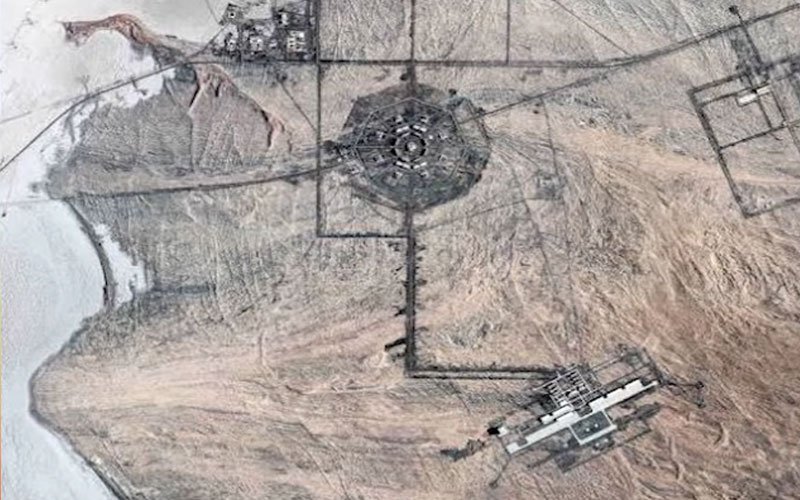
Beijing: China is reportedly accelerating the development of a large-scale military complex in a remote desert region, a move that analysts believe could significantly strengthen the country’s nuclear deterrence and second-strike capabilities amid growing strategic competition among major global powers.
According to assessments based on recent satellite imagery, the site includes more than 80 launch pads, fortified bunkers, and advanced communications infrastructure. Security and defense experts suggest that the facilities may be designed to support the deployment, protection, and operation of long-range missile systems and other strategic military assets.
Analysts have noted that the project appears to be part of China’s broader efforts to modernize its strategic forces and enhance its ability to respond to a potential nuclear attack. The concept of a “second-strike capability” refers to a nation’s capacity to launch a retaliatory response even after sustaining an initial nuclear strike, thereby strengthening deterrence.
Satellite image interpretations indicate that the complex may also incorporate electronic warfare systems, satellite communication networks, and command-and-control centers. Such infrastructure would improve operational resilience and coordination during potential military crises.
Defense observers point out that China already possesses intercontinental ballistic missile (ICBM) systems capable of reaching targets across vast distances. However, the latest construction activity suggests that Beijing is placing increased emphasis on survivability, redundancy, and the protection of its strategic assets.
The reported expansion comes at a time of heightened geopolitical tensions between China and the United States. Strategic competition between the two powers has intensified in recent years over issues ranging from military influence in the Indo-Pacific region to technology, trade, and security concerns. The Taiwan issue, in particular, remains a major source of friction between Washington and Beijing.
Experts say the development reflects a broader trend of military modernization among nuclear-armed nations, many of which are investing heavily in advanced missile systems, command infrastructure, and deterrence capabilities. Such projects are often viewed as efforts to ensure strategic stability while simultaneously enhancing national security.
While Chinese authorities have not publicly detailed the purpose of the reported desert complex, the scale of construction observed in satellite imagery has drawn significant attention from international defense analysts and security researchers.
As global strategic competition continues to evolve, the expansion of military infrastructure linked to nuclear deterrence is likely to remain a closely watched issue for governments, defense experts, and international observers alike.