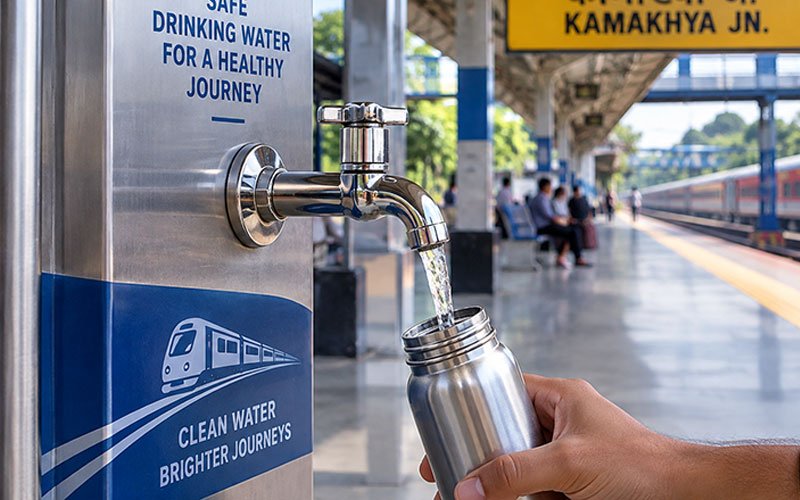
Guwahati: Ensuring access to safe drinking water at major railway stations, the Northeast Frontier Railway (NFR) has intensified its monitoring and testing programme at Guwahati and Kamakhya railway stations.
As part of the latest inspection conducted on September 21, railway authorities collected water samples from locations used by passengers and railway staff. The samples were subjected to laboratory testing to assess their physical and chemical characteristics and verify compliance with prescribed standards.
At Guwahati railway station, a sample collected from the waiting hall was examined for a range of parameters, including pH, turbidity, total hardness, nitrate, iron, residual free chlorine, chloride, alkalinity, fluoride and calcium. According to the test report, the sample remained within the specified permissible limits.
Water quality checks were also carried out at Kamakhya railway station, where two filtered-water samples were collected from passenger-use points. One sample was taken from Platform No. 1, Vat No. 3, while another was collected from Platforms No. 2 and 3, Vat No. 2.
The available physicochemical test results for the Kamakhya samples were found to be within the limits prescribed in the respective reports. Railway authorities also carried out bacteriological testing as part of the assessment to identify any possible microbial contamination.
NFR said water quality monitoring is supported by regular maintenance of the railway’s water-supply infrastructure. This includes cleaning storage tanks and maintaining water coolers, pipelines, taps and other related installations.
The railway stated that corrective measures are taken whenever deficiencies are identified during inspections. Regular sampling, laboratory testing and monitoring of residual chlorine are also carried out as preventive measures.
The initiative forms part of NFR’s broader efforts to maintain hygienic and safe drinking-water facilities for passengers and railway personnel across its network.