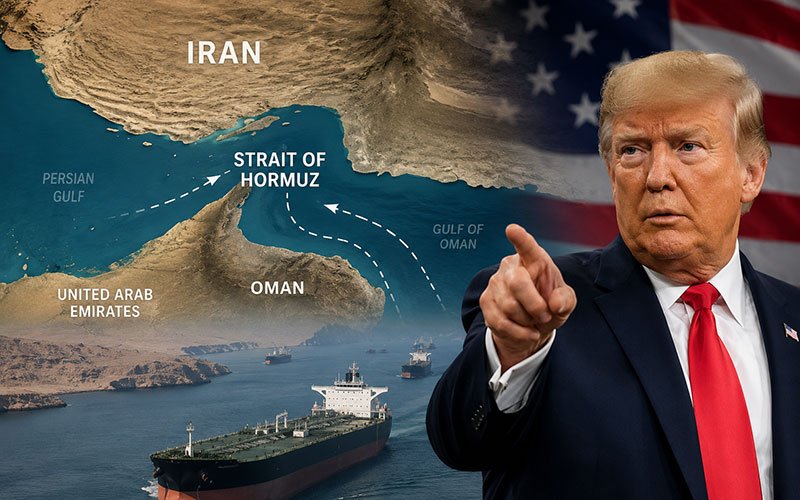
Washington: The Strait of Hormuz could become the key to ending the latest US-Iran confrontation, with US President Donald Trump reportedly prepared to move ahead without securing a new nuclear agreement if Iran fully restores shipping through the strategically important waterway.
A report by The Wall Street Journal, citing US officials, said Trump has been preparing for the possibility of ending the military campaign and extending the existing ceasefire without reaching a comprehensive nuclear deal with Tehran.
Instead, reopening the Strait of Hormuz could become the central condition for Washington to consider the conflict sufficiently resolved.
Iran Sets Conditions for Reopening Hormuz
Iran has reportedly attached a number of demands to any agreement on reopening the waterway. These include financial compensation, an end to the US naval blockade, the withdrawal of American forces from the region, sanctions relief and the release of Iranian assets frozen overseas.
The demands have complicated diplomatic efforts and could make a quick settlement more difficult.
According to the Wall Street Journal report, the issue of Hormuz has increasingly overshadowed the nuclear question as Washington looks for a way to bring the confrontation to an end.
Why the Strait of Hormuz Matters
The Strait of Hormuz is one of the world’s most strategically important maritime routes, connecting the Persian Gulf with the Gulf of Oman and the wider Arabian Sea.
A prolonged disruption to shipping through the strait can affect global energy supplies and push up transportation and fuel costs. The waterway has therefore become a major source of leverage for Tehran during the confrontation.
Iran has restricted access to the strait during the conflict, while Washington has rejected efforts to limit the movement of US naval vessels or impose payments on commercial shipping.
Recent negotiations have also involved Oman, which has been playing a role in efforts to establish arrangements for shipping through the waterway. Iran has said discussions with Oman over the issue were nearing completion, although Tehran continues to link a full reopening to broader demands involving the United States.
Trump Faces Pressure to Deliver an Exit
Trump has repeatedly indicated that reopening the Strait of Hormuz is a priority and has previously suggested that the waterway could soon return to normal operations. However, a complete restoration of commercial traffic has remained unresolved.
The issue carries significant political importance for the US administration as energy prices remain elevated and the midterm elections approach.
A prolonged conflict could increase pressure on the White House to demonstrate a tangible outcome from its military campaign. Securing the reopening of Hormuz could therefore provide Washington with a possible path toward de-escalation without requiring an immediate breakthrough on every unresolved aspect of Iran’s nuclear programme.
For now, however, the positions of Washington and Tehran remain far apart. Whether the two sides can reach an understanding over the Strait of Hormuz—and whether that can ultimately pave the way for a broader political settlement—remains uncertain.
The developments underline the growing importance of the Strait of Hormuz in the US-Iran standoff, with the strategic waterway now emerging as a potential bargaining point in efforts to end the conflict.