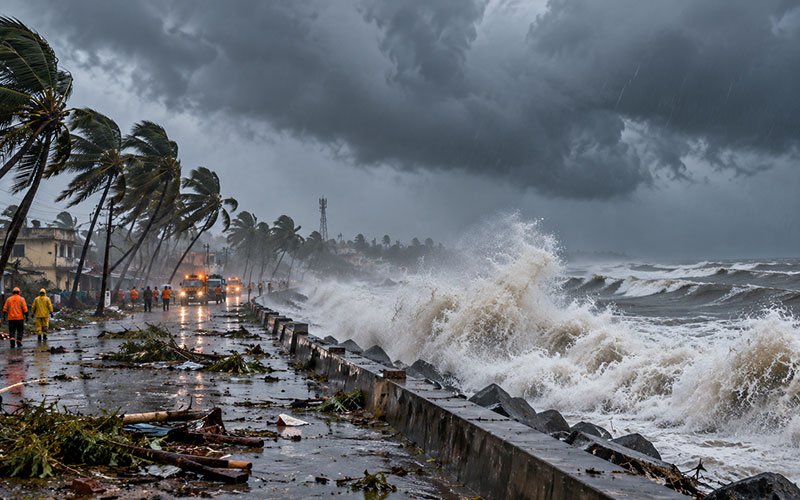
Amaravati: Widespread damage, uprooted trees and power outages have been reported across coastal Andhra Pradesh after Cyclone Arnab struck the region early Wednesday, October 28, bringing destructive winds and torrential rainfall. The powerful storm also affected neighbouring Odisha, prompting large-scale evacuations and disrupting transport services.
The cyclone crossed the Andhra Pradesh and Yanam coastline near Narsapur after a landfall process lasting more than six hours. According to the India Meteorological Department (IMD), Arnab made landfall as a very severe cyclonic storm, with sustained winds of 125–135 kmph and gusts reaching 150 kmph.
The weather system weakened into a severe cyclonic storm by 8:30 am as its centre moved inland. However, authorities continued to warn of heavy rainfall and strong winds across vulnerable areas.
Cyclone-Related Deaths Reported in Andhra Pradesh
Several fatalities have been linked to the cyclone, with victims reportedly killed by falling trees and contact with live electrical wires.
Media reports placed the death toll at five, with incidents reported from Visakhapatnam, Anakapalli, Kakinada, Konaseema and West Godavari districts. However, the National Disaster Response Force (NDRF) separately confirmed three cyclone-related deaths, indicating differences in the casualty figures available during the day.
The storm also damaged houses, uprooted electricity poles and blocked roads in several coastal areas. Emergency personnel began clearing fallen trees and restoring essential services as weather conditions permitted.
Heavy Rainfall and Mass Evacuations
More than 1.8 lakh people were evacuated across Andhra Pradesh and Odisha ahead of the cyclone’s arrival as authorities moved residents from vulnerable coastal and low-lying areas to safer locations.
Heavy rainfall affected several districts, with reports indicating that Visakhapatnam received up to 315 mm of rain by Wednesday morning. Significant rainfall was also recorded in Vizianagaram, Anakapalli, Srikakulam and Krishna districts.
In Odisha, districts including Koraput, Ganjam and Gajapati experienced heavy downpours, raising concerns over flooding and disruption to daily life.
The severe weather also affected air and rail connectivity. Several flights serving Visakhapatnam and Vijayawada were cancelled or suspended, while some train services were disrupted. Educational institutions in affected areas remained closed as a precautionary measure.
Authorities Step Up Relief and Restoration Efforts
Andhra Pradesh Chief Minister N. Chandrababu Naidu directed officials to accelerate restoration work, clear roads obstructed by fallen trees and restore electricity once conditions became safe.
Disaster response teams remained deployed across affected districts, with relief shelters providing accommodation and essential supplies to evacuated residents.
The IMD warned that heavy rainfall could continue across parts of Andhra Pradesh and Odisha on Wednesday and Thursday, even as the cyclone gradually lost strength while moving inland.
Why Was the Cyclone Named Arnab?
The name Arnab was submitted by Bangladesh under the tropical cyclone naming system followed by countries bordering the North Indian Ocean.
Derived from Bengali, Arnab means ocean or sea. The name forms part of a list adopted in 2020 by the World Meteorological Organization (WMO) and the United Nations Economic and Social Commission for Asia and the Pacific (ESCAP) Panel on Tropical Cyclones.
The naming arrangement involves 13 participating countries, each contributing 13 names, creating a list of 169 names for storms developing over the Bay of Bengal and the Arabian Sea.
The system helps meteorological agencies communicate cyclone warnings more effectively and enables the public to distinguish between different weather systems.