
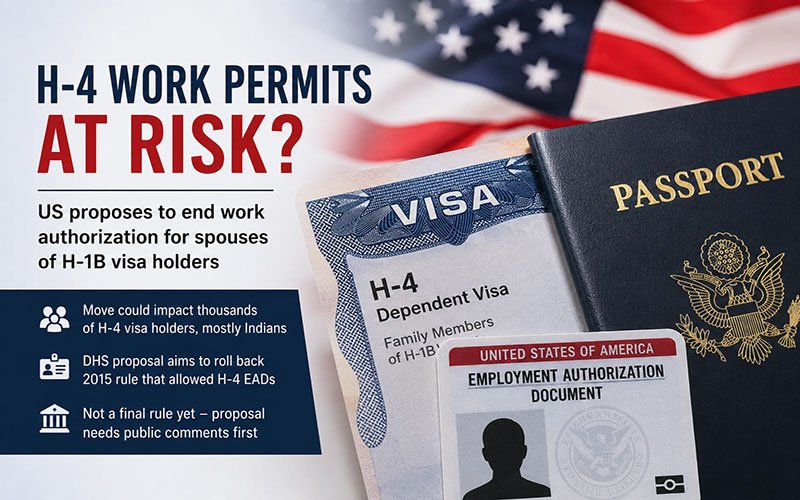
Washington: A possible change to US immigration rules could put the employment rights of thousands of H-4 visa holders under renewed scrutiny, particularly spouses of H-1B workers who have relied on work permits to build careers and contribute to household incomes.
The Department of Homeland Security (DHS) has placed a regulatory proposal on the federal government’s agenda that would remove certain H-4 dependent spouses from the category of noncitizens eligible to apply for employment authorization.
The proposal, titled “Removing H-4 Dependent Spouses From the Classes of Noncitizens Eligible for Employment Authorization,” would effectively roll back the policy introduced in 2015 that allowed eligible H-4 spouses of H-1B workers to obtain Employment Authorization Documents (EADs).
No Immediate Cancellation of H-4 Work Permits
Despite concerns among immigrant families, the development does not mean H-4 employment authorization has been cancelled.
DHS has listed the measure as a long-term regulatory action, and the timetable currently does not provide a date for publication of the formal Notice of Proposed Rulemaking. Any eventual rule would have to go through the federal rulemaking process, including publication, public comments and consideration of those comments before a final decision.
Until a final rule takes effect, eligible H-4 spouses with valid employment authorization remain governed by the existing rules.
Indian Families Could Face Significant Impact
The proposed change is likely to attract particular attention among Indian-American families because Indians make up a large share of the H-1B workforce and have historically represented the overwhelming majority of H-4 EAD recipients.
Data from the early years of the H-4 EAD programme showed that Indian nationals accounted for roughly 93% of approved applications between 2014 and 2017, with women making up about 94% of those recipients.
That makes the proposed policy especially significant for Indian families in which the H-1B worker is the primary visa holder and the spouse has obtained an independent career through an H-4 EAD.
What Is an H-4 EAD?
An H-4 visa is issued to eligible spouses and children of H-1B visa holders. The visa itself does not provide employment authorization.
Certain H-4 spouses, however, can apply for an Employment Authorization Document, commonly known as an H-4 EAD. Under the existing system, eligibility generally applies to spouses of H-1B workers who are further along in the employment-based green-card process.
The EAD allows an eligible spouse to legally work in the United States. Without employment authorization, an H-4 holder can continue to live in the country under the terms of the visa but cannot legally take up employment.
DHS Wants to Reverse the 2015 Policy
The proposed regulatory action would reverse changes made under a 2015 DHS rule that expanded employment authorization eligibility to certain H-4 spouses.
If ultimately adopted, the new policy would restore the earlier framework under which H-4 dependent spouses were generally not eligible to seek employment authorization.
The federal regulatory database specifically identifies the proposal as an effort to remove this class of H-4 spouses from the employment-authorisation category created under the existing regulations.
A Policy Battle That Has Happened Before
This is not the first time the H-4 EAD programme has faced the possibility of being dismantled.
During Donald Trump’s first administration, DHS moved toward eliminating employment authorization for certain H-4 spouses. The earlier effort remained unresolved and was ultimately withdrawn in August 2021. Federal regulatory records show that the previous proposal was formally withdrawn on August 25, 2021.
The latest proposal therefore revives an issue that has previously generated considerable uncertainty among H-1B families.
Broader Pressure on the H-1B Immigration System
The H-4 proposal comes as the Trump administration pursues wider changes to the US employment-based immigration system.
DHS has separately proposed a $103,265 additional fee for H-1B cap-subject petitions, including petitions eligible for the advanced-degree exemption. The proposed payment would be added to other applicable fees and could generate an estimated $8.8 billion annually based on projected filing volumes.
The administration’s broader immigration approach has therefore created fresh uncertainty for foreign professionals, their employers and families who depend on H-1B and related visa categories.
What Happens Next?
For H-4 families, the immediate situation remains unchanged.
The latest DHS entry is still at the regulatory agenda stage. A formal proposal must be published before the public can submit comments, after which DHS would have to consider the feedback before deciding whether to issue a final rule.
That means H-4 EAD holders should not assume that their existing work authorization has suddenly become invalid.
However, if DHS eventually finalises the proposed change, the consequences could be substantial for families that depend on a spouse’s H-4 employment for income, professional continuity and financial independence.
For now, the proposal represents a potential future change rather than an immediate end to H-4 employment rights—but one that could have major implications for Indian H-1B families if it ultimately becomes law.