
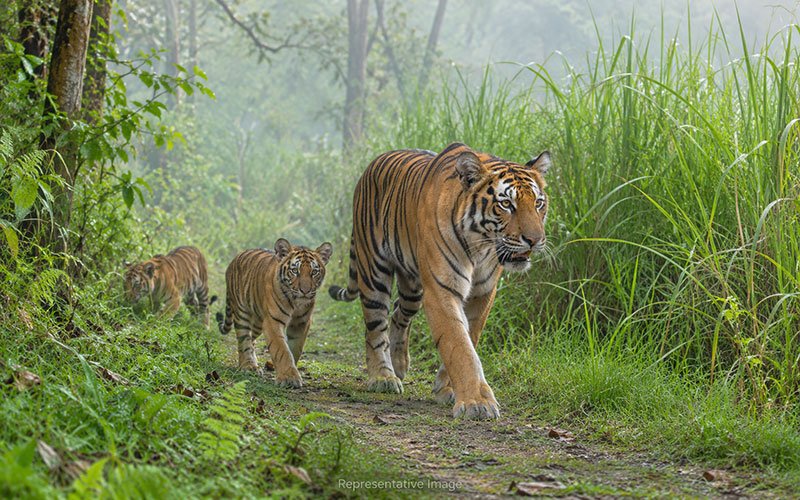
Kaziranga, Assam: Wildlife enthusiasts have been drawn to a remarkable scene reportedly captured inside Assam’s Kaziranga National Park, where a Royal Bengal tigress was seen moving through a forest trail with her two young cubs following closely behind.
The footage, described as having been recorded during a tourist safari in the Kohora Range, offers a fascinating glimpse of a tiger family in its natural surroundings.
While Kaziranga is widely recognised for its population of greater one-horned rhinoceroses, the national park is also an important habitat for Royal Bengal tigers. However, sightings of a mother tiger accompanied by her cubs remain uncommon during regular wildlife safaris.
Tigress Leads Her Cubs Along Forest Trail
According to accounts accompanying the reported video, the tigress was moving along a mist-covered forest path when the two cubs appeared behind her.
One of the young tigers reportedly stopped briefly and looked towards the safari vehicle, while the other remained partially hidden among the surrounding vegetation.
The mother continued walking through the forest, with the cubs following nearby.
The scene has attracted attention because it offers a rare opportunity to observe the behaviour of young tigers outside their usual sheltered surroundings.
However, the original source and recording date of the footage have not yet been independently established.
Why Spotting Tiger Cubs in Kaziranga Is Special
Kaziranga’s landscape consists of expansive grasslands, wetlands, forest patches and dense vegetation, providing excellent natural cover for animals.
Although the reserve supports a substantial tiger population, these predators are often difficult to observe because they spend much of their time away from exposed safari routes.
A tigress accompanied by cubs may be especially cautious, as young tigers depend on their mothers for protection, food and guidance.
Tiger cubs generally remain with their mothers for an extended period, gradually learning essential survival skills before becoming independent.
For visitors exploring Kaziranga, observing such natural behaviour can be an unforgettable wildlife experience.
Kaziranga’s Tiger Population Reaches 148 in Latest Assessment
The reported sighting has also renewed interest in Kaziranga’s achievements in tiger conservation.
According to the Status of Tigers in Kaziranga, 2024 assessment released in July 2025, the tiger reserve recorded 148 adult tigers across three wildlife divisions.
The figure included 83 females, 55 males and 10 animals whose sex could not be determined.
The assessment recorded a tiger density of approximately 18.65 tigers per 100 square kilometres, placing Kaziranga among the world’s leading tiger habitats.
The previous monitoring exercise in 2022 had recorded 104 tigers. However, part of the increase reflects the inclusion of the Biswanath Wildlife Division in the latest survey.
The findings highlight the importance of continued habitat protection, scientific monitoring and anti-poaching measures in the reserve.
Tiger Breeding Highlights Need for Habitat Conservation
The presence of breeding tigresses and young cubs is an important element of maintaining a viable tiger population.
Successful reproduction depends on several conditions, including adequate prey availability, suitable habitat and protection from disturbances.
Kaziranga’s grasslands and forests support a variety of prey species that form part of the tiger’s natural food chain.
Conservation initiatives in the reserve include regular patrolling, wildlife monitoring, habitat management and efforts to reduce threats from illegal activities.
However, the reported appearance of healthy-looking cubs in a single video cannot, by itself, establish their health or survival prospects.
Wildlife specialists generally advise tourists to observe tigers from a safe distance without attempting to approach or disturb them.
Kaziranga Tourism Season Attracts Nature Lovers
The reported sighting has emerged during the 2026–27 tourism season, when Kaziranga welcomes visitors from across India and abroad.
Jeep safaris resumed on October 3 following the annual monsoon closure, while elephant safari operations began in early November.
Kohora, also known as the Central Range, is one of the park’s most popular tourism zones.
The area offers visitors opportunities to observe greater one-horned rhinoceroses, wild elephants, deer, birds and occasionally tigers.
The possibility of witnessing rare wildlife behaviour remains a major attraction for nature lovers and wildlife photographers visiting the national park.
Rare Wildlife Encounters Reinforce Kaziranga’s Importance
The reported encounter between a mother tigress and her two cubs serves as a reminder of the rich biodiversity protected within Kaziranga National Park and Tiger Reserve.
Beyond its reputation as a stronghold of the one-horned rhinoceros, Kaziranga plays a significant role in conserving endangered predators and maintaining the ecological balance of Assam’s floodplain ecosystem.
Although independent confirmation of the particular safari footage remains pending, the sighting described in the video reflects the kind of natural encounter that makes Kaziranga an important destination for wildlife enthusiasts.
Protecting its grasslands, forests and wildlife corridors will remain essential for ensuring that future generations can continue to experience the park’s extraordinary natural heritage.