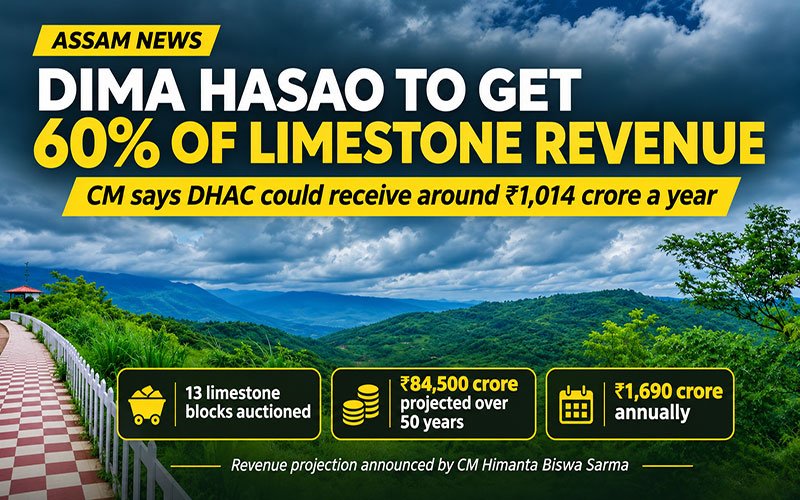
Assam Chief Minister Himanta Biswa Sarma says 13 auctioned limestone blocks could generate Rs 84,500 crore over five decades, with 60 per cent of the projected revenue earmarked for the Dima Hasao Autonomous Council.
Guwahati, November 2, 2026: A substantial new source of income could reshape the finances of Assam’s Dima Hasao Autonomous Council (DHAC), with the state government projecting annual earnings of approximately Rs 1,014 crore for the hill district’s autonomous administration from limestone mining.
Chief Minister Himanta Biswa Sarma outlined the financial projections on Monday, describing the proposed arrangement as an opportunity for Dima Hasao to gain greater control over its development expenditure and reduce its dependence on government grants.
The announcement follows the auction of 13 limestone blocks in the district to cement manufacturers. According to Sarma, the bidding process was conducted transparently and is expected to open a long-term revenue stream for the autonomous council.
Limestone Auctions Projected to Generate Rs 84,500 Crore
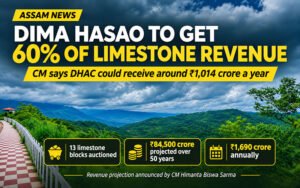
The Chief Minister said the auctioned limestone reserves could generate approximately Rs 84,500 crore over a 50-year period.
Based on these projections, the mining activities would yield an average of Rs 1,690 crore annually.
Under the revenue-sharing arrangement, the autonomous council would receive 60 per cent of the proceeds, equivalent to an estimated Rs 1,014 crore each year.
The remaining 40 per cent would be allocated to the Assam government under the applicable royalty-sharing framework.
The figures represent projected earnings over the life of the mining operations rather than revenue already collected. Actual annual receipts will depend on mineral extraction, production levels and the implementation of the mining projects.
Revenue-Sharing Plan Aims to Strengthen Financial Autonomy
Sarma emphasised that a regular source of mining revenue could provide the Dima Hasao Autonomous Council with greater financial flexibility.
He argued that direct access to these funds would allow the council to plan and finance development initiatives without seeking separate financial assistance from the Assam government or the Centre for every project.
The arrangement is also consistent with the Assam government’s existing framework for mineral revenue distribution in autonomous council areas.
Under a standard operating procedure notified by the state’s Mines and Minerals Department in July 2022, mineral royalties in the Dima Hasao and Karbi Anglong autonomous council areas are to be divided in a 60:40 ratio between the respective councils and the state government.
Industrial Investment Expands in Dima Hasao
The announcement comes amid growing investment interest in cement manufacturing and limestone extraction in the Umrangso region of Dima Hasao.
On October 30, Sarma laid the foundation stone for JK Lakshmi Cement’s proposed Rs 11,000-crore Project Kamakhya.
The project includes plans for limestone mines, an integrated cement manufacturing facility in the Umrangso area and a cement grinding unit at Lanka in Hojai district.
During the event, the Chief Minister also reiterated the government’s decision to allocate 60 per cent of limestone royalty revenue to the autonomous council.
The state government expects the proposed industrial projects to contribute to employment generation and related economic activities.
Mining Expansion Also Raises Land and Environmental Concerns
While the government has highlighted the financial potential of mineral extraction, mining proposals in Dima Hasao have also faced objections from sections of the local population.
Residents and community representatives in parts of the Umrangso area have raised concerns about land rights, water resources, environmental protection and the potential impact of industrial activities on nearby villages.
These concerns have prompted demands for adequate consultation, regulatory safeguards and protection of local livelihoods.
The Assam government’s mining procedures require project operators to obtain the environmental and other statutory clearances applicable to their activities.
Assam CM Links Mining Revenue to Local Development
In his social media statement, Sarma referred to Dima Hasao’s history of insurgency and argued that commercial investment could help strengthen indigenous regions when local institutions receive a substantial share of the resulting revenue.
He presented the limestone revenue-sharing arrangement as an example of how economic development could support greater financial independence for autonomous councils.
For Dima Hasao, the proposed revenue allocation could significantly expand the council’s financial resources if the mining projects achieve the anticipated level of production and earnings.
The pace of implementation, actual revenue collection and the management of environmental and community concerns will remain important factors in determining the long-term impact of the initiative.
Sources: Assam Chief Minister Himanta Biswa Sarma’s statement on X, November 2, 2026; Assam Mines and Minerals Department royalty-sharing notification; and reports on the Umrangso cement and limestone projects.