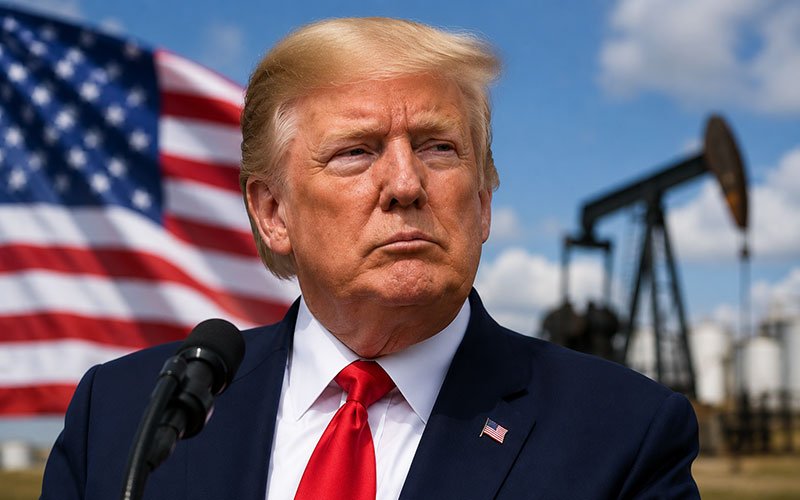
WASHINGTON: A potentially far-reaching oil agreement between the United States and Venezuela could reshape the South American country’s energy sector while giving American companies access to some of the world’s largest untapped crude reserves, President Donald Trump said Friday.
Trump announced the agreement in a social media post, describing it as the largest oil deal in history. He said the arrangement was negotiated by Secretary of State Marco Rubio, Defense Secretary Pete Hegseth and Venezuela’s acting President Delcy Rodriguez.
According to the Venezuelan government, the agreement covers the development of 17 oil fields with an estimated proven potential of 65 billion barrels. Caracas said the project could attract nearly $100 billion in private investment and generate more than $209 billion in tax revenue for the Venezuelan government.
Rodriguez said the agreement could play an important role in reviving Venezuela’s struggling economy.
U.S. company to receive major role
Details released by a U.S. official familiar with the agreement indicate that the United States will work with a private operator to establish a new company responsible for developing the oil reserves.
The proposed arrangement would reportedly give the company rights to develop the fields for 100 years. The United States would have an effective claim to around 55% of the company’s output, through a combination of ownership and rights to purchase crude at cost.
If the arrangement proceeds as described, the new company could become one of the world’s largest corporate holders of proven oil reserves, ranking behind Saudi Arabia’s state-owned Saudi Aramco, the official said.
Oil produced under the agreement is expected to be used partly to replenish the U.S. Strategic Petroleum Reserve and partly for military requirements.
Agreement comes amid pressure over U.S. fuel prices
The announcement comes at a difficult time for the U.S. energy market. American motorists are facing significantly higher gasoline prices, while the conflict involving Iran has disrupted the movement of oil through the Strait of Hormuz.
Around one-fifth of global petroleum supplies passed through the strategic waterway before the conflict, making disruptions there a major concern for international energy markets.
The United States has also been drawing down its Strategic Petroleum Reserve. Its stockpile fell below 300 million barrels in early August, representing a reduction of more than 100 million barrels since the beginning of 2026.
AAA data showed the average U.S. gasoline price at approximately $4.09 per gallon on Friday, compared with about $3.21 a gallon during the same period last year.
Despite the scale of the Venezuela agreement, however, analysts caution that it is unlikely to bring immediate relief at American fuel pumps.
Venezuela faces major production challenges
Venezuela possesses an estimated 303 billion barrels of crude oil reserves, equivalent to roughly 17% of global reserves, according to the U.S. Energy Information Administration.
Much of the country’s underground oil wealth has already been identified. The major obstacle is production capacity. Years of underinvestment, deteriorating infrastructure and political instability have left Venezuela producing only a small share of global crude output.
Restoring damaged facilities, expanding pipelines and rebuilding other essential infrastructure could take years and require billions of dollars in investment.
There could also be challenges in persuading major American energy companies to return to Venezuela after years of political and economic uncertainty.
U.S. oil industry remains cautious
Trump previously met with American oil executives at the White House and urged them to return to Venezuela following the removal of former President Nicolas Maduro.
Although the country’s enormous reserves attracted interest, industry leaders remained cautious because of their previous experiences operating under Venezuela’s political and economic conditions.
ExxonMobil CEO Darren Woods had previously described Venezuela as effectively “un-investable,” reflecting concerns within the industry about the country’s business environment.
Trump, however, has argued that his administration has created greater stability and improved conditions for investment.
Venezuela moves toward privatization
The agreement also follows a major policy shift under Rodriguez’s administration.
One of her early measures after taking power was legislation designed to open Venezuela’s oil industry to greater private-sector participation. The move represents a significant departure from the state-dominated approach associated with the socialist governments that have controlled the country for more than two decades.
Rubio said the new arrangement would bring substantial private investment into Venezuela, create jobs and potentially contribute to lower energy costs in the United States.
Maduro remains in U.S. custody
The agreement also marks another major development in Washington’s relationship with Caracas following the dramatic U.S. operation against Nicolas Maduro.
Maduro remains in U.S. custody and is facing federal charges related to narcoterrorism and drug trafficking. He has pleaded not guilty.
For Washington, the Venezuela deal represents an opportunity to secure additional oil supplies closer to home. For Caracas, it could provide the foreign investment and revenue needed to rebuild an industry that has suffered years of decline.
However, the scale of the proposed agreement means implementation—not the announcement itself—will determine whether Venezuela can significantly increase production and whether the deal ultimately has a measurable impact on U.S. fuel prices.
Source: Based on reports from U.S. and Venezuelan officials and publicly available information.